
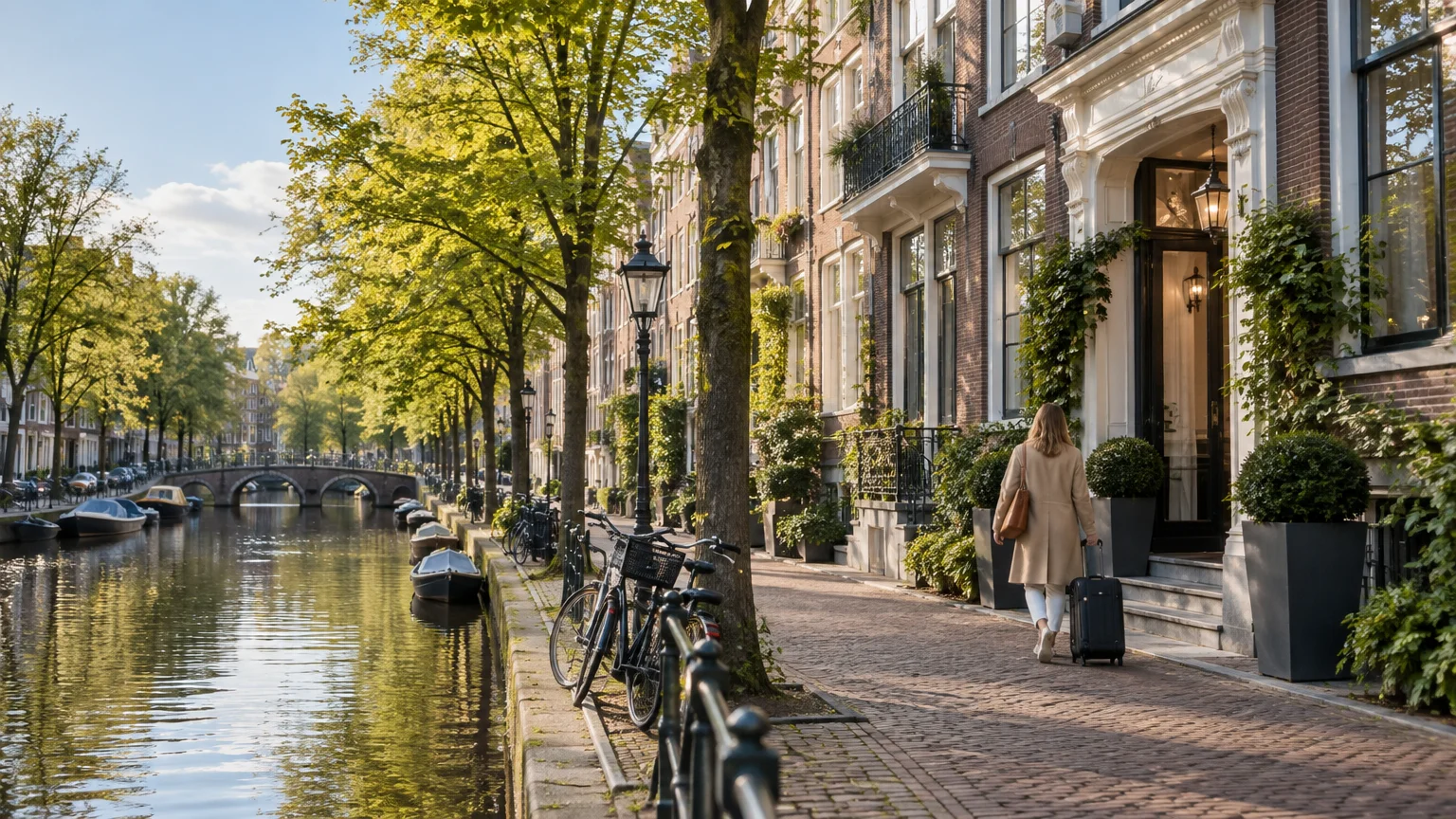
TLDR: The best Amsterdam neighborhoods for a quiet stay are De Plantage for a green, near-central base; Oud-Zuid for museums and residential streets; the Eastern Docklands for modern waterfront surroundings; and the residential edges of Westerpark for local life with useful access to the centre. The Jordaan can work if you choose the street and room carefully, but it is not automatically peaceful. In every area, room orientation, tram tracks, terraces, events and construction can matter as much as the neighborhood name.
Finding the best Amsterdam neighborhoods for a quiet stay requires a realistic definition of quiet. Amsterdam is compact and active: bicycles pass early, trams can rumble by, café terraces stay animated, and old buildings do not all have modern glazing. A calm residential street can still contain a noisy room, while a centrally located hotel may offer excellent sleep in a courtyard-facing room.
The practical goal is therefore not silence. It is to reduce avoidable exposure while keeping the museums, canals, restaurants and transport connections you want. Start with the neighborhood that best fits your days, then investigate the exact block, building and room. If you are still deciding how much centrality matters, compare these options with staying in Amsterdam when you want to walk almost everywhere.
The best Amsterdam neighborhoods for a quiet stay at a glance
| Area | Best for | Main advantage | Tradeoff to check |
|---|---|---|---|
| De Plantage | First-time visitors, couples and families | Green cultural surroundings close to the historic centre | Trams, ARTIS activity and traffic on larger streets |
| Oud-Zuid | Museum-focused trips and park access | Residential atmosphere near Museumplein and Vondelpark | More reliance on trams for some central sights |
| Eastern Docklands | Longer stays and modern waterfront settings | More physical separation from the busiest historic streets | Less convenient if you expect to walk everywhere |
| Westerpark edges | Repeat visitors and travelers seeking local life | Park access with residential streets nearby | Events and temporary transport changes |
| Jordaan | Visitors who still prioritize canal atmosphere | Central location and strong neighborhood character | Markets, bars, attractions and busy pedestrian routes |
None of these choices guarantees a quiet night. The table identifies useful starting points, not measured noise rankings. A rear room in the Jordaan may be calmer than a street-facing room beside tram tracks in a more residential district.
De Plantage: the strongest near-central compromise
De Plantage is often the most balanced starting point for a first visit. I amsterdam calls it the city centre’s green heart and highlights ARTIS, Hortus Botanicus and the Jewish Cultural Quarter among its attractions. It feels less compressed than the busiest parts of Centrum, yet you do not have to give up proximity to major cultural sights.
Choose De Plantage if you want relatively calm surroundings without organizing every day around a long journey into town. It is particularly appealing to couples who prefer greenery to nightlife and to families who want nearby daytime attractions. The neighborhood also suits visitors who expect to divide their time between the eastern side of the centre, the canal belt and Museumplein.
The exact address still matters. Check whether the hotel faces a tram route, a major traffic street or a busy entrance to an attraction. Near ARTIS, daytime family activity may be more relevant than late-night nightlife. A side-street or courtyard-facing room can preserve the neighborhood’s advantages while reducing transport noise.
Oud-Zuid: best for museums, parks and a residential rhythm
Oud-Zuid is the natural choice for travelers whose itinerary revolves around Museumplein and Vondelpark. I amsterdam associates the neighborhood with both and describes it as roughly 20 minutes from the city centre by tram. That makes it less central than the canal ring in walking terms, but hardly isolated.
The benefit is a different daily rhythm. You can begin near museums and green space rather than crossing the centre to reach them. Museum-focused couples, repeat visitors and families who value park time may find that more useful than being close to Dam Square. For a short cultural break, the location can eliminate unnecessary morning travel even if dinner or canal-side sightseeing requires a tram ride.
Do not book based on the Oud-Zuid label alone. Streets close to major roads, tram lines, hospitality clusters or event locations may feel very different from quieter residential blocks. Check the route between the hotel and the nearest stop as well: a slightly more distant room is not a good trade if every outing becomes inconvenient for someone in your group.
Eastern Docklands: more space from the historic core
The Eastern Docklands suit visitors who like contemporary architecture, water and a degree of separation from the busiest central lanes. The district grew from Amsterdam’s maritime landscape and has been reinvented for contemporary city life. Its appeal is not old-Amsterdam romance on the doorstep; it is a modern waterfront base from which to visit that historic city.
This area can work especially well for a longer stay, when returning to a less tourist-focused setting matters more than stepping straight onto a famous canal. It may also appeal to travelers who prefer newer buildings, although building age alone does not prove that a specific hotel has effective soundproofing or climate control.
The tradeoff is dependence on transport. Before booking, map the actual trip from the hotel to two or three places you expect to visit, not merely the distance to Amsterdam Centraal. If you want to walk out of your hotel and spend the entire day sightseeing on foot, choose closer to the centre. If using trams or buses feels routine, the added separation may be worthwhile. Amsterdam is generally manageable without a car, but neighborhood choice changes how often you need transit; our guide to where to stay in Amsterdam without renting a car explains that broader decision.
Westerpark: calm residential edges with an event caveat
Westerpark combines substantial green space with residential surroundings west of the Jordaan. It is a good candidate for repeat visitors who want local streets, park access and reasonable connections rather than a hotel amid the most heavily visited canals.
The important word is edges. A hotel near a quiet residential block may offer a very different experience from one exposed to activity at Westergas or a busy approach road. Look at the event calendar for your dates and locate the hotel relative to venues, terraces and park entrances. Amsterdam’s permit system also makes clear that large events can involve practical arrangements such as traffic measures or temporary use of public space.
Transport deserves extra attention in the western centre. GVB states that Oranje Loper works suspend tram traffic through Rozengracht and Raadhuisstraat until February 2027, affecting travel through parts of the western canal area. Do not assume that an old hotel description or map reflects the service operating on your dates.
Can the Jordaan work for light sleepers?
Yes, but only as a carefully selected central compromise. The Jordaan combines canals and neighborhood character with cafés, Noordermarkt, the Anne Frank House and other popular destinations. Those qualities make it appealing, but they also generate pedestrian activity, deliveries, market setup and evening noise in particular locations.
Choose the Jordaan when central canal atmosphere matters more than finding the lowest-risk neighborhood for noise. Favor a side street away from bar clusters and major walking routes, then ask for a room facing a courtyard or the rear of the property. Check whether a market operates nearby and whether guests repeatedly mention bells, voices, loading activity or thin internal walls in recent reviews.
The western canal ring also requires a current transport check because of the works affecting Rozengracht and Raadhuisstraat. A disruption does not make the area a poor choice, but it can alter the convenience calculation. A hotel that looked ideal because of a nearby tram may temporarily require a longer walk or a replacement route.
Areas to approach carefully when quiet is the priority
De Pijp is lively rather than restful by default. Its café terraces and bustling markets are central to its appeal, so it is a less natural match for travelers seeking a strictly quiet base. A well-insulated rear room may still work, but the burden is on the property and room choice rather than the neighborhood.
Apply similar caution to the busiest parts of Centrum, especially streets dominated by nightlife, late-opening businesses, visitor traffic or major transport flows. These locations can be excellent for a short, energetic trip. They are less forgiving if you are a light sleeper, have young children or need predictable rest between full sightseeing days.
This does not mean every central hotel should be rejected. It means you should demand more specific evidence: recent room-level reviews, a credible answer from the hotel about orientation, and a map showing what operates immediately outside.
A hotel noise checklist that matters more than star rating
Once you have chosen an area, investigate the property rather than relying on a broad neighborhood reputation. Our full Amsterdam hotel booking checklist covers the wider building and policy questions; for a quieter room, concentrate on the following points.
- Ask for a courtyard-, garden- or rear-facing room, and request confirmation that it does not face tram tracks, a loading area or a busy terrace.
- Ask whether the windows open and whether the room has air conditioning. Closed windows only help if the room remains comfortable.
- Ask what soundproofing is present, but treat a general assurance cautiously. Double glazing does not address noise from corridors, lifts or neighboring rooms.
- Use a map to identify tram tracks, larger roads, cafés, markets, schools, churches, music venues and construction sites immediately around the hotel.
- Read recent reviews for the exact room category where possible. Search within them for street noise, internal noise, bells, trams, deliveries and temperature.
- Check whether an event is scheduled in a nearby park, square or venue during your stay.
- Repeat the transport and construction check shortly before departure because conditions can change after booking.
If sleep is essential, contact the hotel before choosing a non-refundable rate. Ask a concrete question such as, “Which room category can be assigned away from the street and lift?” That is more useful than asking whether the hotel is quiet, which invites a subjective answer.
Check transport twice: before booking and before arrival
GVB operates Amsterdam’s metro, tram, bus and ferry network, with many IJ ferry crossings free for pedestrians and cyclists. Use the official GVB disruptions and diversions page alongside its journey planner when comparing a hotel’s access. GVB notes that maintenance and city events can cause planned diversions.
For airport travel, NS states that the Sprinter journey between Schiphol Airport and Amsterdam Centraal takes about 17 minutes, while advising passengers to check current information because engineering work occurs around Schiphol. The scheduled rail journey is only part of your arrival plan: add the transfer from Centraal or another station to your hotel, plus walking time with luggage.
Travelers who need step-free routes should verify the specific stops and transfers rather than relying on a neighborhood’s general accessibility. GVB provides step-free guidance, and its live planning information can help account for accessible stops and disruptions involving lifts or escalators.
Which quieter area should you choose?
- For a first visit: Start with De Plantage. It offers a useful balance of greenery, cultural sights and near-central access without placing you in the most intense part of Centrum.
- For a museum-focused couple: Choose Oud-Zuid, particularly if Vondelpark and Museumplein will anchor your days.
- For a family: Compare De Plantage with Oud-Zuid. Decide whether nearby attractions or park access will simplify your routine, then check room size and orientation.
- For a longer stay: Consider the Eastern Docklands if you are comfortable using public transport and prefer a modern waterfront setting to historic streets outside the door.
- For local life and park access: Look at the residential edges of Westerpark, but inspect the event calendar and current western transit routes.
- For canal character above all else: Choose the Jordaan selectively. Prioritize a side street and rear-facing room rather than assuming the whole district will be calm.
The practical conclusion
De Plantage is the best all-round starting point for a relatively calm first visit, while Oud-Zuid is stronger for museums and park-oriented days. The Eastern Docklands reward travelers willing to trade walk-everywhere convenience for more separation from the historic core, and Westerpark works well when its residential character—not a nearby event—is shaping the stay.
Whichever neighborhood you choose, make the final decision at room level. Map the block, inspect recent reviews, ask about orientation and climate control, and check live events and transport twice. In Amsterdam, the difference between a restorative stay and a noisy one may be one street, one façade or one room assignment rather than an entirely different neighborhood.
References
- De Plantage | I amsterdam
- Oud-Zuid | I amsterdam
- Oostelijke Eilanden then and now | I amsterdam
- Westerpark then and now | I amsterdam
- Apply for an event permit | City of Amsterdam
- GVB
- Things to do in the Jordaan | I amsterdam
- Best ways to experience Amsterdam like a local | I amsterdam
- visit-amsterdam-gvb-public-transport-company-amsterdam | GVB
- travel-information-disruptions-diversions | GVB
- Travel to the airport by train | Travel | NS
- Step-free access public transport