
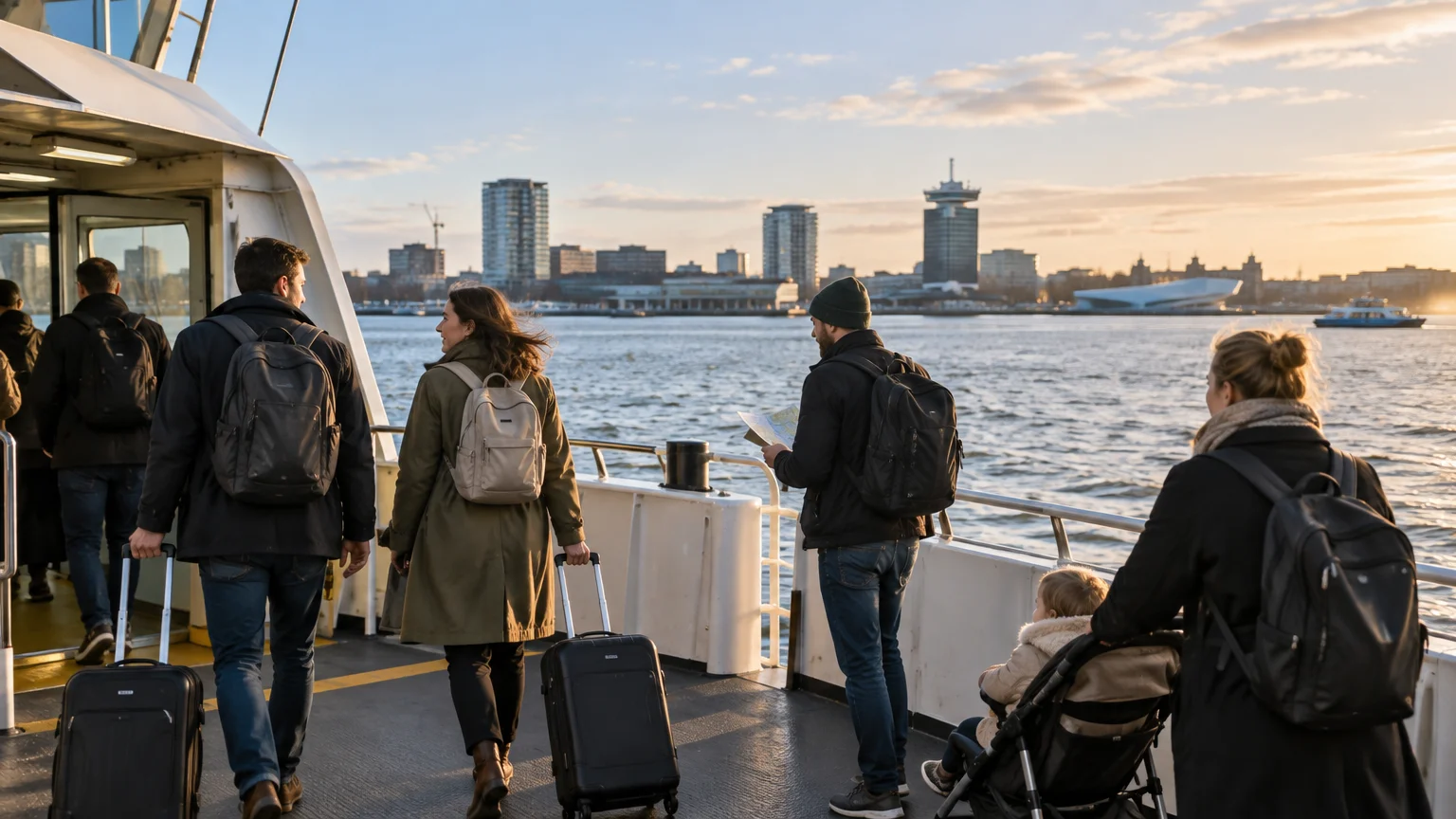
TLDR: Most ferries visitors use in Amsterdam are free GVB public-transport crossings over the IJ, not paid sightseeing cruises. The most useful routes leave from the waterside of Amsterdam Centraal for Buiksloterweg, NDSM and IJplein. This Amsterdam ferry guide explains which crossing fits each destination, how boarding works and why a ferry-dependent hotel can be either refreshingly convenient or one transfer too many.
The basic decision is simple: use the Buiksloterweg ferry for attractions and hotels in southern Noord, and the NDSM ferry for the former shipyard district. Check the destination display at the pontoon rather than boarding whichever vessel arrives first. For hotel planning, judge the complete route from the accommodation to the pontoon—not merely whether the address says “Amsterdam Noord.”
Public ferry or canal cruise?
Amsterdam’s ferries and canal cruises share the water but serve different purposes. The GVB ferries are functional crossings linking parts of the city across the IJ. Canal cruises are paid sightseeing experiences designed to show passengers Amsterdam from its waterways.
| Option | Primary purpose | Typical cost arrangement | Best for |
|---|---|---|---|
| GVB IJ ferry | Crossing the IJ as part of a journey | The visitor-facing IJ crossings are free | Reaching Noord, NDSM and waterfront attractions |
| Commercial canal cruise | Sightseeing on Amsterdam’s canals | Paid ticket or qualifying sightseeing product | Seeing canal houses, bridges and the historic center from the water |
GVB distinguishes the free IJ services from North Sea Canal crossings farther west, where pedestrians, cyclists and mopeds travel free but motor vehicles pay. For an ordinary city visit, the ferries behind Centraal are the relevant network.
Amsterdam ferry guide to the useful routes
Three crossings behind Amsterdam Centraal matter most to visitors: Buiksloterweg, NDSM and IJplein. Official visitor information identifies the pontoons behind the station as their central boarding area. Route numbers are useful, but the destination name on the electronic board is the detail to follow.
| Route | Destination | Best use for visitors | Hotel-location implication |
|---|---|---|---|
| F3 | Buiksloterweg | EYE Filmmuseum, Tolhuistuin and southern Noord | Potentially convenient when the hotel has a genuinely short, simple walk from the landing |
| F4 | NDSM | NDSM Wharf, events, restaurants and accommodation around the former shipyard | A deliberate daily crossing if most sightseeing is in the historic center |
| F2 | IJplein | IJplein and nearby eastern parts of Noord | Useful for a specific address, but not a substitute for checking the exact hotel-to-pontoon walk |
| F9 | Zeeburgereiland–Sporenburg | A local east-side connection for pedestrians and cyclists | Usually of limited value for a first-time itinerary based around Centraal or central Noord |
Buiksloterweg for EYE and southern Noord
The Buiksloterweg crossing is the default choice for EYE Filmmuseum, Tolhuistuin and the waterfront directly opposite Centraal. Its value is not just the short water crossing: arriving behind Centraal puts you next to national rail, metro, tram and bus connections.
That can make a well-positioned southern Noord hotel feel more central than its location north of the IJ suggests. The important qualifier is “well-positioned.” A room near the waterfront landing and a room several kilometres deeper into Noord may share a district name while producing very different daily journeys.
NDSM for the former shipyard district
Take the NDSM crossing when NDSM Wharf is the destination. This is the route that aligns with the district’s industrial waterfront setting rather than the Buiksloterweg landing. It is useful in its own right, not merely a scenic alternative to another ferry.
Staying at NDSM can suit repeat visitors, event-goers and travelers who actively want its atmosphere. It is a more considered choice for a first visit dominated by Canal Ring walks, museum appointments and evenings elsewhere. Every trip into the center begins with reaching the landing, waiting for the crossing and then continuing from Centraal.
IJplein and the less tourist-oriented crossings
The IJplein ferry serves a different part of Noord and may be the right answer for a particular accommodation address. Do not choose it simply because an online map makes two waterfront points look close. Walking routes, barriers and the location of the actual landing matter.
Other ferries serve local journeys beyond the standard visitor circuit. For example, GVB lists F9 between Zeeburgereiland and Sporenburg as a pedestrian-and-cyclist connection. It can be useful for the right east-side journey, but most first-time visitors do not need to build an itinerary around it.
How to catch a ferry behind Amsterdam Centraal
From the station, follow signs toward the IJ or ferries and leave on the waterside, opposite the city-center entrance. The pontoons sit behind the station. Electronic displays show destinations and departure countdowns, helping passengers distinguish between adjacent routes.
- Confirm the destination you need before joining a boarding area.
- Read the electronic board at the pontoon; do not rely only on where the vessel appears to be pointing.
- Let arriving passengers leave before moving down the ramp.
- Keep luggage close and avoid stopping where bicycles and other passengers need to circulate.
- After landing, reopen your map for the final walk instead of assuming the waterfront exit faces your hotel.
You do not need an OV-chipkaart, GVB pass or separate ticket for the free IJ crossings. GVB’s official explanation of Amsterdam ferry fares and crossing types is the best place to confirm whether a less familiar route falls into the same category. The distinction matters if your plans extend to the North Sea Canal crossings or involve a motor vehicle.
Is a Noord hotel convenient?
It can be, but “Noord” is too broad to answer the question on its own. A southern Noord hotel with an easy walk to Buiksloterweg can work smoothly for visitors who expect to pass through Centraal every day. A property near NDSM offers a more distinctive base but adds a longer, more deliberate transfer. Hotels deeper in the district may work better with Metro 52 or buses than with any ferry.
Compare the location with what you plan to do after dinner as well as before breakfast. A morning ferry can feel like an enjoyable start to the day. The same extra transfer may feel less charming when returning tired, in poor weather or with children. If your priority is stepping outside and walking directly to most historic-center sights, compare Noord with an Amsterdam hotel location suited to walking everywhere.
Noord often makes the most sense when the accommodation itself, its immediate waterfront setting or a nearby event is part of the reason for booking. It makes less sense when the only argument is a slightly lower room rate that will be offset by additional travel time.
Bicycles, strollers, wheelchairs, pets and mopeds
GVB publishes conditions for bicycles, mopeds, mobility aids, pets and strollers, and states that microcars are not allowed on its ferries. Rules can vary by vehicle or passenger category, so check the current conditions rather than treating every wheeled item alike.
The main ferries use broad boarding ramps. I amsterdam says wheelchairs and mobility aids are permitted, while GVB provides priority for wheelchair users in designated spaces. That does not guarantee that the entire journey is step-free. The pavement between a hotel and the landing, station lifts, temporary works and the final route after disembarking all affect accessibility.
Travelers with a stroller or large suitcase should make the same door-to-door assessment. The ferry crossing itself may be straightforward, but cobbles, kerbs and a longer-than-expected waterfront walk can be the difficult part. When comparing rooms, add access and luggage questions to the broader list of checks to make before booking an Amsterdam hotel.
Night travel, weather and disruptions
Do not assume every ferry runs all night or that every route has the same operating pattern. Night service, frequency and seasonal schedules are route-specific and can change. A hotel description that calls the ferry “frequent” is not a substitute for checking the service you need at the time you expect to travel.
Before a late return, consult the GVB journey planner and current departure information. GVB also publishes diversions and service disruptions, which should be checked close to travel when a missed crossing would materially affect your plans. Keep a second route in mind, such as metro, bus or taxi, particularly after an event or when traveling with children or luggage.
Weather changes the experience more than the basic practicality. Ferries are everyday transport, but waiting by an exposed waterfront can feel cold or wet in wind-driven rain. Pack for the wait as well as the crossing, and allow extra time when crowds are moving to or from a major event.
Checklist before booking a ferry-dependent hotel
- Map the walking route from the hotel entrance to the correct ferry landing, not merely to the waterfront.
- Check which route serves the hotel and whether that route fits your likely morning and late-evening travel times.
- Compare the ferry journey with Metro 52, bus and taxi alternatives.
- Look for lifts, kerbs, steep ramps or rough surfaces if traveling with mobility equipment, a stroller or substantial luggage.
- Calculate the whole trip to your priority sights, including waiting and the onward journey from Centraal.
- Check whether event nights, maintenance or current disruptions could affect the crossing.
- Decide whether the Noord or NDSM setting is a positive part of the trip or simply a compromise made for the room rate.
The practical choice
Amsterdam’s free IJ ferries are easy to use once you match the landing to the destination. Choose Buiksloterweg for EYE, Tolhuistuin and nearby southern Noord; choose NDSM for the former shipyard district; and use IJplein when your exact address makes that crossing the logical one.
For accommodation, resist treating every Noord hotel as equivalent. A short walk to Buiksloterweg can create a smooth connection through Centraal, while an NDSM stay makes the waterfront crossing a more substantial part of each day. Choose Noord for its space, atmosphere or a particular property—not because a map makes every point across the IJ look equally close.